

• More Than 225 Americans to Deliberate on the Future of U.S. Science in Simultaneous Forums Across Three States

    American Science @250 brings together people of all ages, backgrounds, and perspectives in Boston, Charleston, and Phoenix to consider who should conduct, fund, prioritize, and oversee publicly funded research

    ASU Consortium for Science, Policy and Outcomes

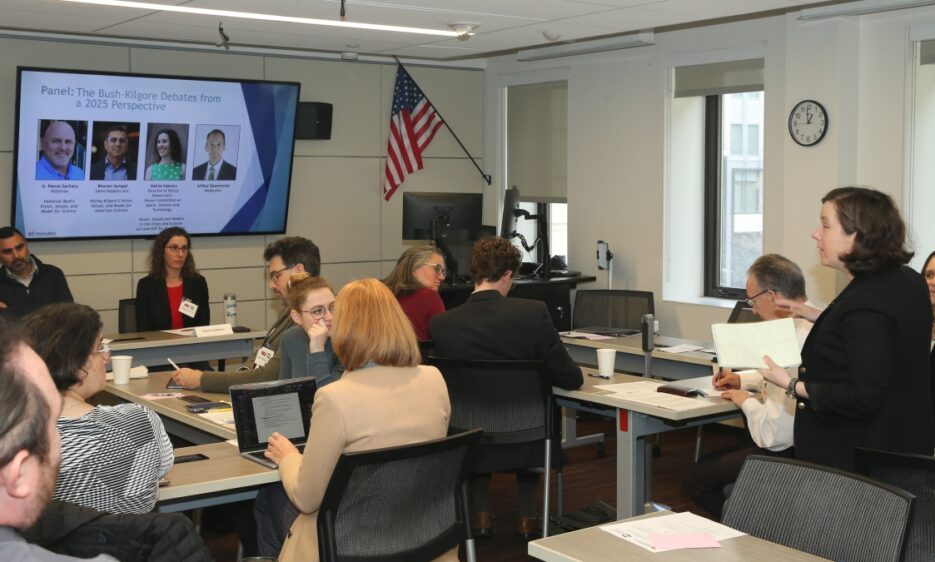
    More than 225 Americans will gather in Boston, Massachusetts; Charleston, West Virginia; and Phoenix, Arizona, on Saturday, October 3, for a national experiment in public deliberation about the future of the American scientific enterprise.

    The three American Science@250 Citizen Forums, organized by Arizona State University’s Consortium for Science, Policy & Outcomes (CSPO) with partners in each state, will engage members of the public in a full day of informed, facilitated discussion to explore a question usually left to scientists, universities and policymakers: Who should decide what publicly funded science is for and how it should be organized.

    Read more »

  • 🌞 CSPO Summer 2026 Newsletter 🌞

    Summer may be in full swing, but the work at CSPO isn’t taking a vacation. Our team continues to launch policy-relevant programs, drive positive change, and advance use-based, community-oriented policy work. Read on for upcoming events, thought-provoking ideas, and practical insights you can put to work.

    Read more »

  • Advisor: Fixing America’s biotechnology governance system will take a major shift

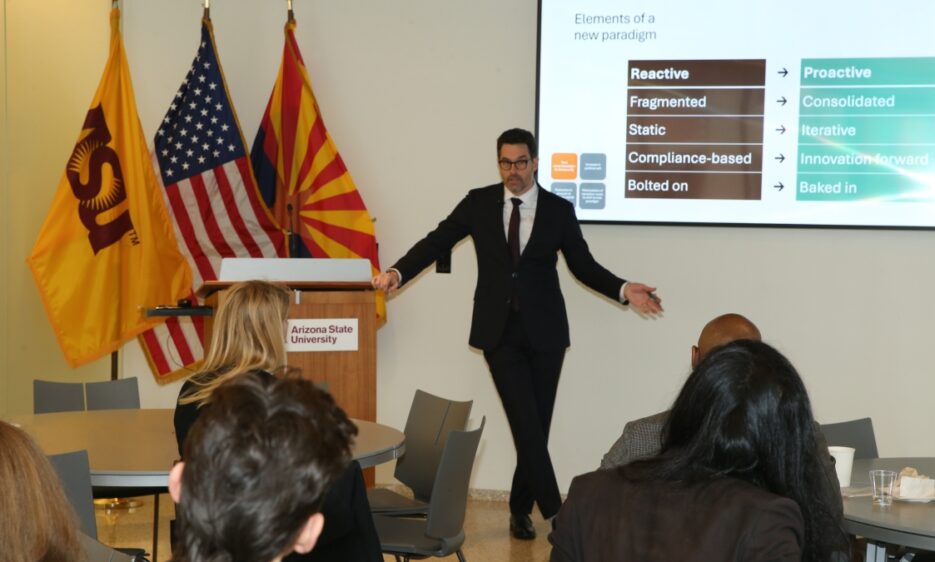
    Sam Weiss Evans, senior advisor at the Federation of American Scientists, discusses today’s fragmented biosecurity and biosafety systems at the Consortium for Science, Policy & Outcomes’s “Forging a New Paradigm in Biosecurity Governance” event at the ASU Barrett & O’Connor Center in Washington, D.C. Photo courtesy of Hager Sharp

    Read more »

  • ⛄ CSPO Winter 2026 Newsletter ⛄

    Not quite buried under DC’s “snowcrete,” the CSPO team is charging ahead—organizing new policy-relevant programs, driving positive change, and advancing use-based, community-oriented policy work. Read on for events to attend, ideas to wrestle with, and insights you can put to work.

    Read more »

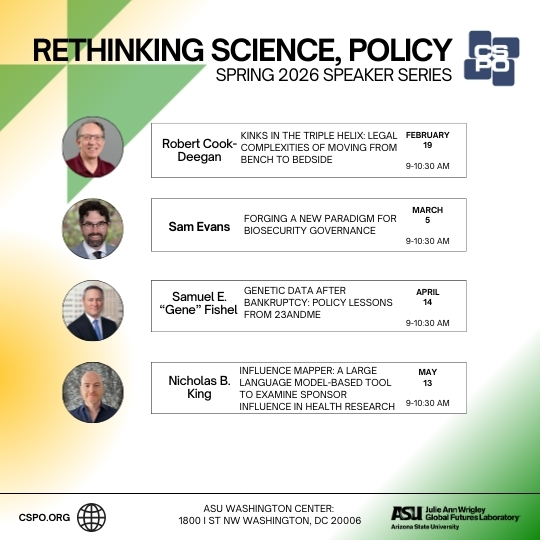
  • Spring 2026 Program Series

    CSPO’s Spring 2026 series focuses on biotechnology and the emerging life sciences

    Read more »

  • ASU center committed to advancing New American University’s model for science funding in US

    The Consortium for Science, Policy and Outcomes launches a new series of collaborative dialogues to help shape science policy

    Read more »

View all CSPO news »

The Consortium for Science, Policy & Outcomes

Is an intellectual network aimed at enhancing the contribution of science and technology to society’s pursuit of equality, justice, freedom, and overall quality of life. CSPO creates knowledge and methods, cultivates public discourse, and fosters policies to help decision makers and institutions grapple with the immense power and importance of science and technology as society charts a course for the future.

Learn more » Study with Us »

Blog: As We Now Think

Bottom-up Activism

The battles that began in the 1970s produced “institutional innovations” across the landscape of academic science and industrial research. These innovations were not limited to top-down actors, but also infused bottom-up activism – and state and local experimentation – that effectively democratized science technology and the public interest in ways never envisioned (or even favored) by Vannevar Bush.

Read more »

Technopolis’ Flat-Earther Problem

Something about the current debate over artificial intelligence felt remarkably familiar: the people building the most powerful systems are also among those warning most loudly that these systems could destroy us. Technological and policy elites are often exceptionally good at seeing two dimensions of change: how fast and in which direction. What they too often flatten is the third dimension: public value.
Read more »

Science: A Long Wave

One of the genuinely surprising aspects of OSTP’s new Science: A New Golden Age is its invocation of the linear model, as if American science policy has remained trapped within Bush’s institutional architecture for eighty years. The report presents itself as a fundamental rethinking of a system built around assumptions inherited from Bush. But the system has been adapting to the inadequacies of that model for half a century.

Read more »